How Do You Decide When a Scene Is Worth Waiting For?
Some photographers don’t wait at all. They see something, shoot it immediately, and move on—then wonder why the image feels thin.
Others wait too long. They become emotionally invested in a scene improving, keep “holding position,” and walk away with nothing but fatigue and frustration.
The goal isn’t patience for its own sake. The goal is good judgement: knowing when a scene is likely to reward waiting, when it requires movement, and when it’s already done.
This is a decision problem, not a motivation problem.
Below is a straightforward framework you can use in real environments—street, travel, events, markets, cafés—anywhere the world refuses to cooperate.
The Core Decision: Will This Scene Get Better If I Wait?
Before you commit time, ask one question:
Is the scene missing a moving element that is likely to arrive soon?
If the answer is yes, waiting is rational.
If the answer is no, waiting is usually wishful thinking.
Most scenes fail because the photographer is waiting for a feeling (“something cool might happen”), not a specific missing piece.
So define the missing piece.
Common missing pieces that justify waiting:
- A person entering a clean space you’ve already framed
- A gesture that completes an interaction (handover, glance, pause, decision)
- A brief alignment (subject + background + light + spacing)
- A moment of separation (one subject breaks from a group, a face turns, a step isolates)
If you can’t name what’s missing, you are not waiting—you are stalling.
A Simple 3-Option Rule: Wait, Move, or Leave
Every time you stop, you’re choosing one of three actions:
- Wait (hold position because a specific element is likely to appear)
- Move (reposition because the scene needs you to change angle, distance, or background)
- Leave (the scene won’t improve, or the cost of waiting is too high)
Your job is not to “get the shot.” Your job is to choose the correct action fast enough that you don’t lose momentum.
Choose WAIT when:
- The background/setting is already strong
- The empty space is “ready” (a stage waiting for an actor)
- You can name the missing element
- That missing element is likely to appear soon
Choose MOVE when:
- The scene has potential, but your angle is the problem
- The background is messy and needs a cleaner frame
- The moment is happening, but you’re not in the right place to read it clearly
- You can’t see a path for improvement without changing position
Choose LEAVE when:
- Nothing is missing—this is as good as it gets
- The scene is not stable (too chaotic to resolve)
- The “missing piece” is unlikely to appear
- Waiting has no clear end point
This is the whole game: pick the right verb.
The “Stage Test”: Is There a Frame That Can Support a Moment?
Waiting only works when the frame can carry meaning.
So look for a stage:
- A clean background that won’t compete with the subject
- A defined area where people pass through
- A visual structure (doorway, counter, kiosk, lane, light patch, shadow edge)
- A compositional boundary that creates a “slot” for a subject
If you have a stage, you can wait for an actor.
If you don’t, waiting is usually pointless, because even if something happens, it won’t land cleanly.
Practical cue:
If you can point to a specific rectangle in the scene and say, “when someone enters here, the image becomes complete,” then waiting makes sense.
If you can’t do that, you are hoping, not waiting.
The “Likelihood Test”: How Predictable Is This Flow?
Some environments have predictable movement. Some don’t.
Waiting works best when the world is repeating itself:
- People walking through the same gap
- Customers approaching the same counter
- Vendors repeating the same motion
- Commuters crossing the same line
- Tourists stopping at the same spot to look, shoot, or decide
The more predictable the loop, the more likely your wait will pay off.
Low predictability environments (where waiting often fails):
- Large crowds with no clear path
- Open plazas where people scatter randomly
- One-off street drama that ends instantly
- Tourist chaos where every angle gets blocked
High predictability environments (where waiting often pays):
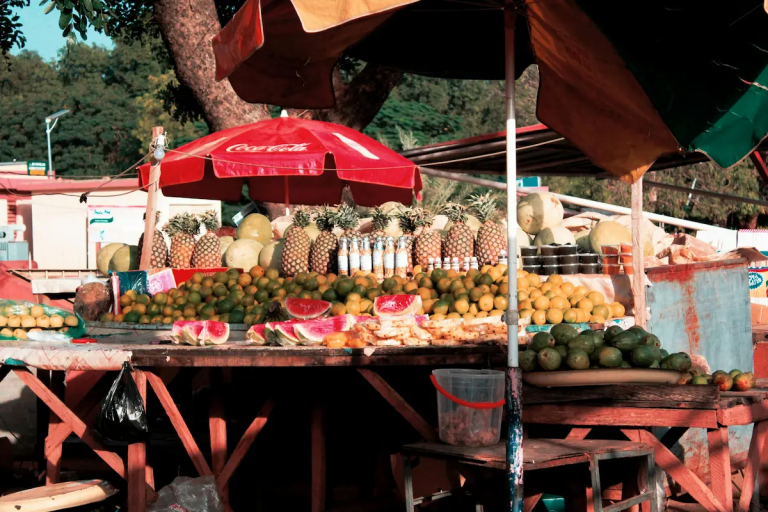
- Food stalls with constant transactions
- Doorways and entrances
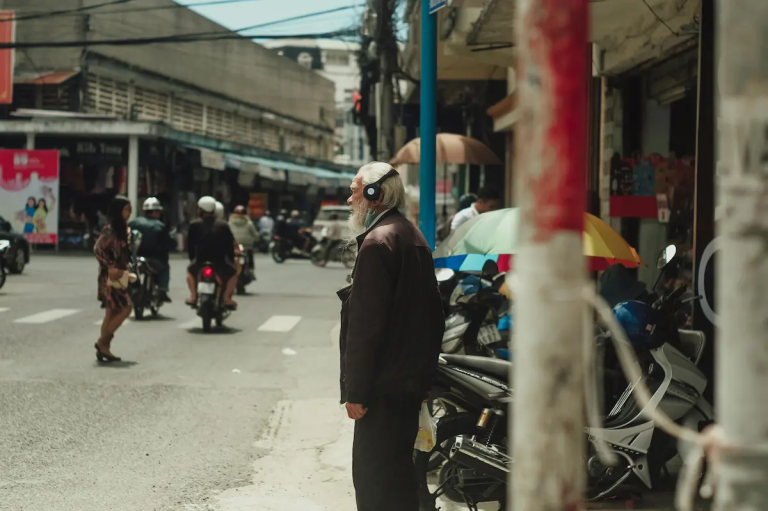
- Crosswalks and narrow passages
- Café counters
- Market aisles
If the movement is not repeating, you need to move, not wait.
The “Cost Test”: What Are You Paying to Wait?
Waiting feels free because you’re not doing anything.
But waiting has costs:
- You miss other scenes nearby
- Your attention narrows and becomes rigid
- You lose creative momentum
- You start forcing meaning into weak setups
So give waiting a budget.
A clean working rule:
If you can’t describe what will change within the next few minutes, you’re not waiting—you’re camping.
Waiting should be a short, purposeful hold, not a lifestyle choice.
Decision Format: The 4-Question Checklist (Use This in the Street)
When you stop, run these four questions quickly:
1) Is the frame already strong without the subject?
If the answer is no, you probably need to move.
2) What exactly is missing?
Name it in one sentence:
- “A person entering the light patch.”
- “A buyer’s hand reaching then leaving.”
- “A face turning to the other person.”
If you can’t name it, you probably need to leave.
3) How likely is it to happen here?
If the environment is repeating (transactions, doorway flow, loops), waiting is logical. If it’s random, it’s not.
4) What’s my exit trigger?
You must define a stop condition:
- “If three people pass and none fit, I leave.”
- “If the light changes, I leave.”
- “If the space stays blocked for two minutes, I move.”
No exit trigger = endless waiting = bad behaviour.
This checklist is short enough to use in real time, and it forces clarity.
The Common Failure Mode: Waiting for a “Good Person”
A lot of photographers pretend they’re waiting for “the moment,” but they’re really waiting for a person who looks interesting enough to rescue a weak frame.
That’s not a moment problem. That’s a stage problem.
If the frame can’t support a normal person, it can’t support a good person either—because you’re relying on novelty, not structure.
A stronger approach:
- Build a frame that would work with any person
- Then wait for the person who completes it best
This flips your logic from subject hunting to scene building.
When Waiting Is the Wrong Tool (and Movement Is the Right One)
Here are situations where waiting is usually a trap:
The background is actively getting worse
More people, more clutter, more distractions. Waiting is not going to simplify the world. You need a different angle or a different scene.
The moment you want requires proximity you don’t have
If the image depends on expression, interaction, or micro-gesture, and you’re too far away to read it, waiting won’t fix that. Movement will.
The scene doesn’t have a “slot”
If there’s no clean space for a subject to enter, waiting just accumulates randomness.
You’re waiting for a miracle
If the missing element is unlikely (a perfect couple, a dramatic gesture, someone looking directly into the right light), then you’re gambling. That may be fine occasionally, but don’t base your workflow on it.
In all these cases, the “professional” decision is not patience. It’s repositioning or leaving.
A Better Way to Think About “The Moment”
Most people talk about “capturing the moment” as if the moment is the subject.
In practice, the moment is usually the change—the shift from one state to another:
- walking → stopping
- looking away → noticing
- holding → releasing
- approaching → deciding
- speaking → reacting
- moving together → separating
Waiting makes sense when a scene is close to a change and you have reason to believe the change is coming.
If nothing is about to change, waiting is dead time.
The Confidence Rule: You Should Feel Calm, Not Desperate
A good wait feels calm because you’re holding a strong setup.
A bad wait feels desperate because the scene is weak and you’re hoping for salvation.
That emotional difference is diagnostic.
If you feel yourself getting tense, irritated, or overly attached, it usually means:
- you don’t have a clear missing element, or
- your exit trigger is undefined
Reset. Choose a verb. Move or leave.
This kind of tension often comes from over-preparing instead of observing, a pattern explored further in When Preparation Gets in the Way of Seeing.
Practical Examples of Exit Triggers (Use These)
Here are a few exit triggers you can borrow:
- Pass count: “If 10 people pass through and none fit, I move.”
- Time cap: “If nothing changes in 2 minutes, I leave.”
- Block rule: “If the stage stays blocked for 30 seconds, I reposition.”
- Light shift: “If the light patch disappears, I’m done.”
- Energy change: “If the interaction ends, I leave—no waiting for a sequel.”
Exit triggers prevent the most common waste: continuing to wait after the scene is already gone.
Learning when to leave is often harder than learning when to wait, a decision explored more deeply in Missed Moments: When Letting a Shot Go Is the Right Call.
Closing: The Calm Way to Improve Your Hit Rate
Waiting is not a virtue. It’s a tool.
Use it when:
- the frame is strong
- the missing piece is clear
- the environment is repeating
- the odds are rational
- the exit trigger is defined
If any of those are missing, waiting becomes a time sink.
The best photographers don’t wait more. They wait better.
Question to leave you with:
When you last waited for a scene, what exactly were you waiting for—and did you have a clear point where you’d move on?